
How much does a Level 3 teaching assistant get paid in the UK? Level 3 Teaching Assistants (TAs) are usually paid on what’s called mid-range NJC pay points. In simple terms, this means their hourly pay is around £13.70 to £15.60 outside London. The rate is a bit higher in London, where salaries include extra allowances to match the higher cost of living.
It’s also important to know that most teaching assistant jobs are term-time only. This means you’re paid for the weeks you work during the school year, not for all 52 weeks of the year. Because of this, the salary is pro-rata, which simply means your total yearly pay is adjusted to reflect term-time working. Level 3 TAs often have more responsibility than entry-level assistants, supporting both teachers and students in the classroom. Their pay reflects this extra experience and qualification level.
In this blog, we’ll look more closely at what affects a Level 3 TA’s pay, how it compares across regions, and what you can expect if you’re thinking about this as a career.

What Does a Level 3 Teaching Assistant Do?
A Level 3 Teaching Assistant helps both teachers and students every day. They often work with small groups or individual pupils, running short, focused activities to help children learn specific skills like reading, writing, or maths. They also give extra help to students with Special Educational Needs (SEN). This could mean changing how a lesson is taught, giving one-to-one support, or helping a child understand things in a different way.
Level 3 TAs also keep simple records of how pupils are doing — what’s going well and where they need more help. They share this information with the teacher or the school’s SENCo (Special Educational Needs Coordinator).
Sometimes, they even lead parts of a lesson or run small-group learning on their own, under the teacher’s or SENCo’s guidance.
How Much Does a Level 3 TA Earn per Hour?
A Level 3 Teaching Assistant usually earns between £13.70 and £15.60 per hour outside London. Pay in London is often higher because of local allowances.
The exact amount depends on the SCP (Spinal Column Point) or grade listed in the job advert. Each school or local authority sets this based on experience and responsibilities, so it’s always best to check the details in the advert before applying.
How Much Does a Level 3 Teaching Assistant Get Paid?
For a Level 3 Teaching Assistant, the full-time equivalent (FTE) salary usually sits around £23,000 to £27,000 per year. However, most TA jobs are term-time only, meaning you’re paid for around 38 to 40 weeks of the school year rather than the full 52 weeks. Because of this, your real take-home pay is lower than the FTE figure — but it’s usually spread evenly over 12 months, so you still receive a regular monthly payment.
In simple terms, the headline salary (FTE) shows what you’d earn if you worked all year round, but the actual yearly pay is pro-rata, based on the school weeks you work.
If you’d like to see how this compares to SEN Teaching Assistant pay, check out our detailed guide here: How Much Does a SEN Teaching Assistant Earn? — it explains typical rates, allowances, and what affects pay for SEN roles.
Does Pay Change in London and High-Cost Areas?

Yes — pay is higher in London and nearby high-cost areas because schools add London weighting or fringe allowances on top of normal NJC pay. In London, this means the hourly rate can reach around £16–£19 or more for the same NJC points that pay £13.70–£15.60 elsewhere.
- Inner London pays the most.
- Outer London and Fringe areas pay slightly less, but still more than the rest of the country.
- Some high-cost areas outside London also offer small pay increases or bonuses to attract staff.
Even with these higher rates, most jobs are term-time only, so the yearly salary is still pro-rata and spread evenly over 12 months.
Starting Pay vs Experienced Level 3 TA Pay
When you start as a Level 3 Teaching Assistant, your pay depends on the grade in the job advert and how you move up over time.
- Starting point: Most new TAs begin on SCP 8–10 (about £13.50–£14.30 per hour outside London).
- Progression: With good performance, you usually move up one point each year.
- Experienced rate: Top Level 3 TAs reach SCP 16–17 (around £15.50 per hour outside London).
- London pay: Rates are higher due to London weighting.
- Check adverts: Each school or trust may use a different grade or scale, so always check the details.
Do SEN Duties or HLTA Progression Increase Pay?
Yes — taking on extra jobs can help you earn more as a Level 3 Teaching Assistant. If you work with children who have special educational needs (SEN), the job is often on a higher pay grade or includes a small extra payment.
If you move up to become a Higher Level Teaching Assistant (HLTA), your pay usually goes up again. HLTAs are paid more because they help with planning lessons, leading group work, or covering classes when the teacher is away.
Simply put, SEN work or HLTA roles can both mean better pay and more chances to grow in your job.
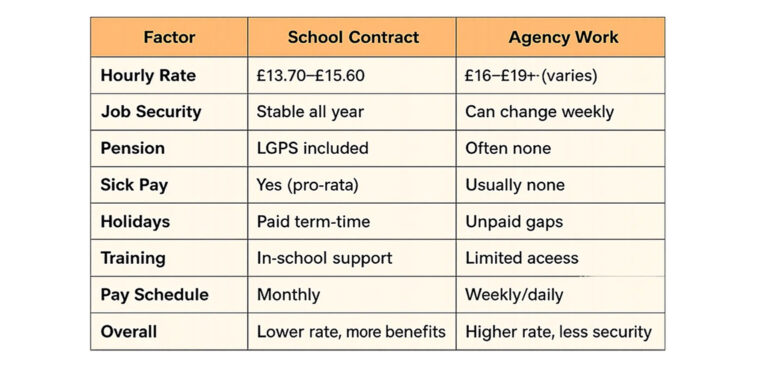
School Contract vs Agency Work: Which Pays More?
Extra Hours, Clubs and Cover: Can You Boost Your Pay?

Yes — many schools let you earn extra pay by doing more hours or helping with extra activities. Some schools pay more for:
- Breakfast or after-school clubs
- 1:1 support hours with specific pupils
- Class cover when a teacher is away
These extra jobs are usually paid at your normal hourly rate or slightly higher. Not every school offers them, so it’s a good idea to ask what extras are available when you apply or during your interview.
How to Increase Your Level 3 TA Salary (Skills & Courses)
If you want to earn more as a Level 3 Teaching Assistant, building new skills and taking extra training can make a big difference. Many schools reward extra qualifications with higher pay grades or specialist roles. Here are some of the best ways to boost your salary:
1. Build Strong SEN Skills
Learning more about Special Educational Needs (SEN) is one of the best ways to progress. Training in areas like autism, ADHD, speech and language, or learning difficulties can help you qualify for SEN support roles, which are often paid slightly higher or include an SEN allowance.
SEN skills are always in demand, and schools value TAs who can adapt learning for pupils who need extra help.
2. Learn Phonics and Literacy Support
If you work in an early years or primary setting, phonics training is extremely useful. Programmes such as Read Write Inc., Letters and Sounds, or Jolly Phonics are widely used across UK schools. Being able to lead small reading or literacy groups makes you more valuable — and may help you move up a grade or secure extra paid hours.
3. Develop Behaviour Support Skills
Many schools also look for TAs who can manage and support children with behavioural or emotional needs. Short courses in behaviour management, positive handling, or restorative practice can really help. These skills are often linked to higher-graded posts or additional responsibilities, such as mentoring pupils or leading small intervention groups.
4. Train as an ELSA
An ELSA (Emotional Literacy Support Assistant) works with pupils who struggle with confidence, friendship issues, or emotional regulation. Training as an ELSA adds a specialist skill to your role — schools often pay more for it, and you may get set hours each week to run ELSA sessions.
5. Progress to HLTA
If you’ve gained experience and confidence, the next step is to become a Higher Level Teaching Assistant (HLTA). HLTAs are on a higher pay grade and can take on more responsibility, such as leading lessons, covering classes when teachers are absent, or planning learning activities. Many TAs see HLTA as the next step in their career.
6. Keep Learning and Updating Your Skills
Even short online CPD courses or local authority training days can make a difference. Schools appreciate staff who show a willingness to keep learning — and this can help you move up faster on the pay scale.
Final Thoughts: What to Expect from Level 3 TA Pay
Level 3 Teaching Assistants earn a fair, steady income with clear chances to move up. Outside London, pay is usually £13.70–£15.60 an hour, rising to £16–£19+ in London and nearby areas. Most roles are term-time only, so pay is pro-rata, spread over 12 months. As you gain experience and take on extra duties—like working with SEN pupils, running clubs, or moving up to HLTA level—your pay and job prospects both improve. If you want to boost your earnings and stand out for promotion, you can also take extra training courses. A great place to start is the Teaching Assistant Course from Unified Course. It’s an online, flexible course that helps you learn key classroom skills and earn a certificate to support your next career step.
Frequently Asked Questions (FAQ)
1. How much does a Level 3 teaching assistant earn in the UK?
- Level 3 TAs usually earn around £13.70–£15.60 per hour outside London, or £16–£19+ with London weighting.
2. How much is a TA paid per hour?
- Most teaching assistants earn between £12 and £16 an hour, depending on level, experience, and location.
3. Can a Level 3 TA become a teacher?
- Yes — many Level 3 TAs go on to teacher training through routes like SCITT, School Direct, or university courses.
4. How much does a Level 3 earn yearly?
- The full-time equivalent is around £23,000–£27,000, but actual term-time pay is pro-rata (based on 38–40 working weeks).
5. What are TA pay scales?
- TA pay follows the NJC scale, which lists pay by Spinal Column Points (SCPs) — each point means a small yearly pay rise.
6. How much is Level 3 salary?
- Level 3 TA salary sits between SCP 8–17, depending on experience, roughly £13.50–£15.60 per hour outside London.
7. What is a teacher pay scale?
- Teacher pay scales also use points (M1–M6 for classroom teachers, UPS for experienced staff), separate from TA grades.
8. How much do police earn?
- Starting police salaries are around £28,000–£30,000, increasing with rank and service.
9. How much does a Level 4 earn?
- Level 4 TAs (often HLTA or senior support roles) earn roughly £16–£19 per hour, or £26,000–£30,000 FTE depending on area.