
Safety starts with the right tools and proper checks. A PAT testing kit helps you test electrical equipment quickly and safely. To stay fully compliant, always follow the IET 5th-edition Code of Practice and the rules under the Electricity at Work Regulations 1989.
A good PAT testing kit has more than just the tester. It should also include adapters, labels, a calibration certificate, and simple records like IDs. Most manufacturers say you should check the calibration every year to make sure it works correctly. In terms of cost, entry-level testers start at about £230–£400. Mid-range kits usually cost £550–£1,400. Professional bundles with extra tools and software can reach £1,000–£2,350 or more.
So let’s dive in and see what makes a PAT testing kit truly useful.
What Is a PAT Testing Kit?
A PAT testing kit is a set of tools used to check portable electrical equipment and make sure it is safe to use. The main tool in the kit is the PAT tester, which quickly shows if devices are working correctly and safely.
Besides the tester, a complete kit has leads and adapters for different types of plugs. It also includes labels to show if equipment has passed or failed and a carry case to keep everything organised. Many kits come with a simple guide or manual that explains the correct way to test equipment.
The IET Code of Practice gives clear instructions on what equipment to test, how often to test it, and the proper steps to follow. Using a PAT kit prevents accidents, and rules are followed.
What Should a Good PAT Testing Kit Include?
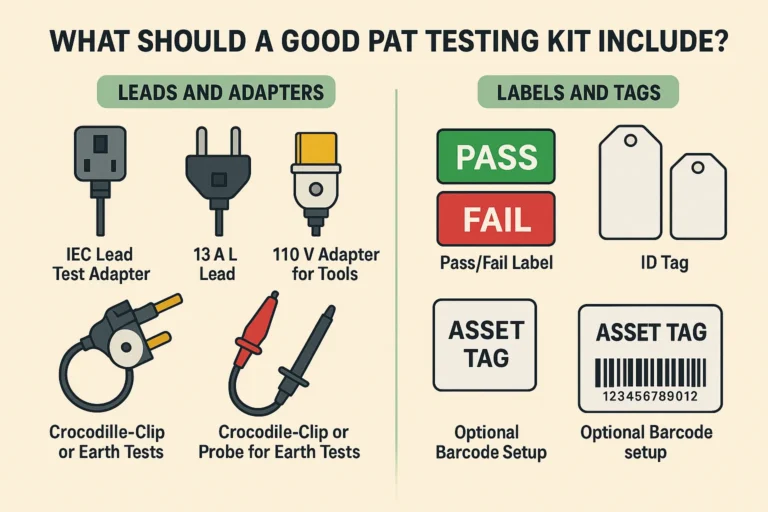
A proper PAT testing kit has more than the tester alone. The tester checks Class I and Class II equipment, tests leads, and measures leakage, keeping everything safe and up to standard.
To test different plugs and tools, the kit also needs the right leads and adapters:
- IEC lead test adapter
- 13 A lead
- 110 V adapter for tools
- Extension-lead adapter
- Crocodile-clip or probe for earth tests
You also need labels and tags to keep track of your testing and results:
- Pass/fail labels
- ID tags
- Asset tags
- Optional barcode setup for digital record keeping
On top of that, a complete kit should include a carry case, a quick-start or CoP guide, and a calibration certificate. Most kits come calibrated for 12 months, so you can test equipment safely and confidently every time.
Do You Need Training to Use a PAT Tester?
UK law does not say you must take a specific course for PAT testing. But it does say that testing must be done by a competent person. This means someone who can spot faults, choose the right tests, and understand the results correctly.
The best way to become competent is by taking training. Training helps you master the steps and checks needed for testing. It also helps you test equipment safely and confidently every time.
What Features Make a PAT Tester Easy to Use?
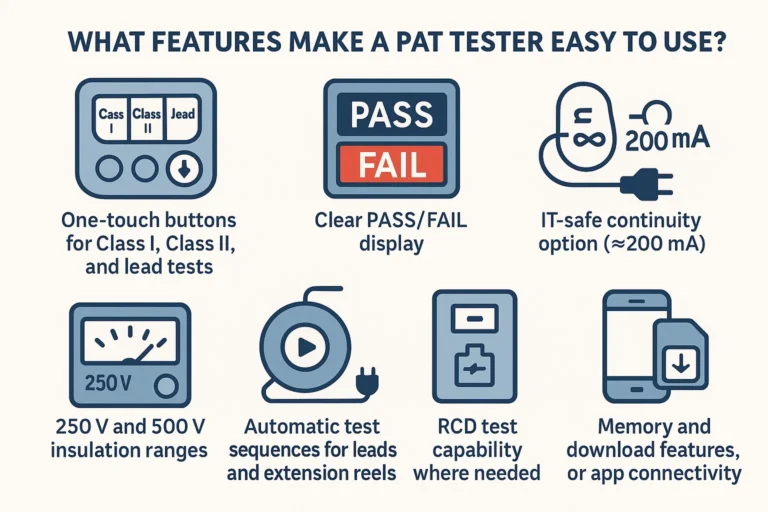
The right PAT tester comes with features to make testing safe and quick. These main features are:
- One-touch buttons for Class I, Class II, and lead tests
- Clear PASS/FAIL display
- IT-safe continuity option (≈200 mA)
- 250 V and 500 V insulation ranges
- Automatic test sequences for leads and extension reels
- RCD test capability where needed
- Memory and download features, or app connectivity for certificates and asset histories
These features make testing easier and more reliable. For example, the one-touch buttons and clear display let you complete daily tests quickly. At the same time, IT-safe continuity and adjustable insulation ranges protect sensitive equipment. Automatic sequences and RCD testing save time and reduce mistakes. On top of that, memory and app connectivity help you save records and track equipment history, keeping you organised and confident every time you test.
Which Devices Are Class I, II, or III in PAT Testing?
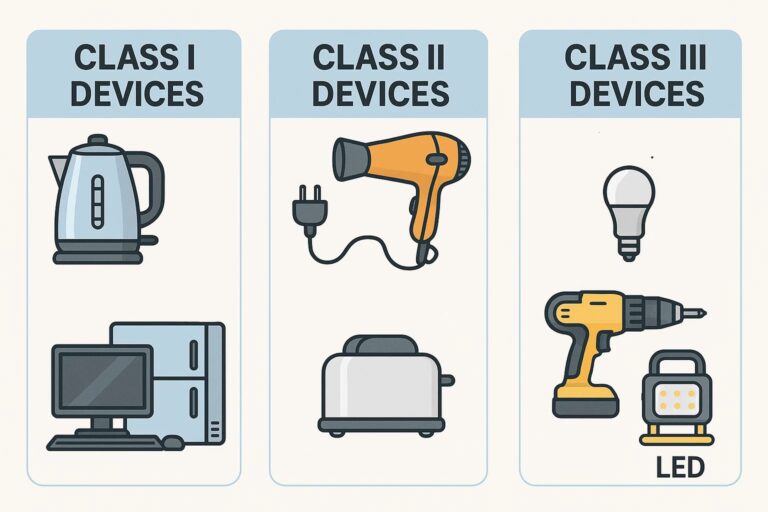
Not all electrical devices are tested the same way. Knowing the class helps you choose the right PAT testing kit and test safely:
- Class I devices – Have metal parts that could carry electricity if something goes wrong. They need an earth connection. Examples include kettles, fridges, and desktop computers. PAT testing checks earth continuity, insulation, and leakage to keep users safe.
- Class II devices – Are double-insulated, so no earth connection is required. Examples include phone chargers, hair dryers, and small kitchen appliances. Testing focuses on insulation and leakage, making sure the device is safe to use.
- Class III devices – Run on very low voltage and stay safe without earth or extra insulation. Examples include battery-powered tools and some LED lights. Usually, a visual inspection is enough to check safety.
Why it matters: Using the wrong tester can give wrong results or even harm your device. Knowing the device class helps you test safely, quickly, and correctly every time.
How Accurate Should a PAT Testing Kit Be?
A PAT testing kit must give correct results to keep equipment and people safe. That is why you should choose a tester with traceable calibration, preferably UKAS or ISO 17025 certified. You should recalibrate it every year, or sooner if it gets damaged or used a lot, so you can always trust the results.
You should also follow the IET 5th-edition methods and limits. Many testers come with presets for earth-continuity and insulation that follow the latest safety rules. These presets save time, reduce mistakes, and make testing easier and more reliable.
What Extra Accessories Are Useful?
A PAT testing kit works better with some extra accessories. For example, a 110 V site adaptor and IEC C13/C19 or fig-8 adaptors help you test different types of leads easily. An RCD test plug lets you check safety devices quickly and safely.
You can also use a label printer or barcode scanner to keep your records neat and organised. If you have many pieces of equipment, results software can store and track all your testing data. This saves time and makes sure all records are correct.
How Much Does a Good PAT Testing Kit Cost?
The price of a PAT testing kit depends on what features you need. Entry-level testers are simple. They only check pass or fail and do not save results. These usually cost around £230–£440 (ex-VAT). They are good for small offices or light use.
If you need more functionality, mid-range kits give extra features like memory, download options, and additional tests. They usually cost about £550–£1,360 (ex-VAT) and work well for busy offices or workshops.
Professional bundles offer even more, including printers, software, and advanced testing tools. Prices start near £1,000 and may rise up to £2,350 or more (ex-VAT). Knowing the price range lets you plan and pick the kit that works best.
Where Can You Buy a Reliable PAT Tester?
You can get a reliable PAT tester from authorised distributors that sell trusted brands like:
- Seaward
- Fluke
- Megger
- Martindale
- Kewtech
Top suppliers include:
- RS Components
- Test-Meter
- Tester.co.uk
These suppliers also offer calibration services to keep your tester accurate and ready to use.
When picking a tester, always check that it follows the IET 5th-edition Code of Practice. Also, check what comes in the kit. Make sure it has all the tools and accessories you need to test safely and efficiently every time.
Can You Use Any PAT Testing Kit on Any Device?
Not every PAT testing kit works for all devices. Electrical equipment is usually Class I or Class II, and each needs different tests. Class I devices, like kettles or computers with metal parts, need an earth continuity check. Class II devices, like phone chargers or small kitchen appliances, are double-insulated and do not need an earth test.
Some tools, such as high-voltage equipment or IT devices, are more sensitive. They need testers with adjustable voltage or IT-safe options. Using the wrong tester can give wrong results or even damage the device. By choosing the right PAT testing kit, you make sure every test is safe, accurate, and fully compliant.
Final Thoughts on Choosing a Good PAT Testing Kit
Choosing the right PAT testing kit depends on how you use it and how many devices you test. For small offices with only a few devices, a basic entry-level tester is enough. But if you work in a busy workshop, school, or hire outlet, a mid-range or professional kit is better. These kits often have memory, download options, and barcode tools, which make testing faster and easier to manage.
No matter which PAT testing kit you choose, always use it with proper training and clear steps. Check the calibration regularly to make sure it works correctly. Doing this keeps your equipment safe, prevents accidents and helps you follow the law.
FAQs
Can I do my own PAT testing?
- Yes, you can. Just make sure you know what you’re doing and follow safe practices. Training helps.
Can you PAT test without being an electrician?
- Absolutely. You don’t need to be a qualified electrician, but you must be competent.
Is PAT testing being phased out?
- No. PAT testing is still widely used to keep equipment safe.
Is a PAT test required every 5 years?
- Not exactly. How often you test depends on the equipment and how often it’s used.
Do I legally need to PAT test?
- UK law says your equipment must be safe. PAT testing is the easiest way to prove it.
Is PAT the same as EICR?
- No. PAT tests your portable appliances, while EICR checks fixed wiring in the building.
Can an electrician do a PAT test?
- Yes. Electricians can do it, but anyone trained and competent can carry out PAT testing safely.