
At some point the question stops being theoretical. You find yourself holding your phone at an uncomfortable distance, or taking your glasses off to read something up close, or squinting at a screen that felt perfectly clear six months ago. An optician confirms what you already suspected, and suddenly you are choosing between reading glasses and varifocal glasses without a clear sense of which direction makes more sense for your life.
Both work. Both have genuine advantages. The right choice depends on factors that have nothing to do with which option sounds more sophisticated and everything to do with how your days actually look.
The Core Difference
Reading glasses do one thing. They correct near vision, typically for distances between 25 and 40 centimetres, which covers reading, close work, and looking at a phone. Put them on for those tasks, take them off for everything else. Simple, affordable, and effective for exactly what they are designed to do.
Varifocal glasses do several things within a single lens. The upper portion handles distance vision. The lower portion handles near vision. The corridor running between them covers intermediate distances, including screens, dashboards, and anything at arm’s length. One pair of glasses, continuously, for everything.
The decision between them is essentially a decision about convenience versus simplicity, and which of those matters more to you specifically.
When Reading Glasses Make Sense
Reading glasses are underestimated. They are often treated as the lesser option, a stopgap before the proper solution, but for a significant number of people they are genuinely the better fit.
If your distance vision is good and presbyopia is the only thing affecting you, reading glasses cover the problem cleanly without requiring an adaptation period, without the peripheral blur that comes with varifocal lenses, and without the cost difference. A well-made pair of prescription reading glasses delivers sharp, comfortable near vision with none of the complexity.
They also make sense for specific task contexts. Someone who spends most of their working day at a desk reading documents, or a craftsperson who needs clear close vision for detailed work, benefits from a lens optimised entirely for that distance rather than a compromise lens that covers multiple distances moderately well.
The honest limitation is the switching. Putting reading glasses on and taking them off repeatedly throughout the day becomes a habit quickly enough, but it is a habit nonetheless. Misplacing them is a genuine daily risk. And for anything at intermediate distance, a standard pair of reading glasses will not perform well.
When Varifocal Glasses Make More Sense
Varifocal glasses suit people whose days involve constantly shifting between distances. Looking up from a document to speak with a colleague. Checking a screen and then looking across a room. Driving and then reading a map or dashboard. Managing all of those transitions with a single pair of glasses, without removing or swapping anything, is a meaningful quality of life improvement once the adjustment period is behind you.
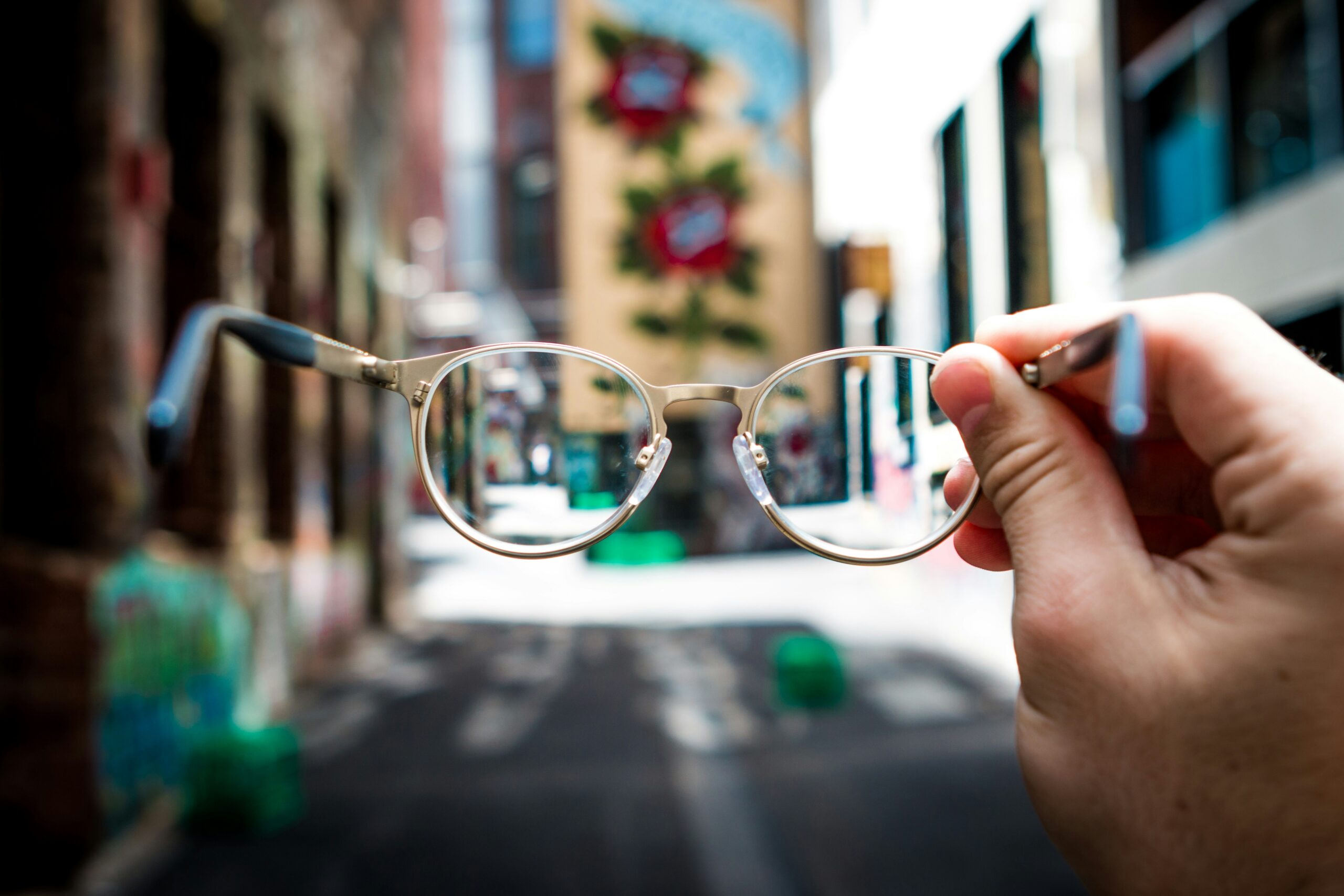
The adaptation period is real and worth knowing about honestly. In the first week or two of wearing varifocal glasses, most new wearers notice some peripheral blur at the edges of the lens, a mild swimming sensation when moving the head quickly, and a need to point the nose rather than just move the eyes to find the right focal zone. These are temporary. They resolve as the brain learns to use the lens, usually within one to two weeks of consistent wear.
Premium varifocal lenses shorten that adaptation period and deliver a wider, more comfortable intermediate corridor. If budget allows, the step up from entry-level to mid-range progressive lenses is noticeable in daily comfort and generally worth the difference.
The Screen Problem Both Options Miss
This is the part that catches people out. Neither standard reading glasses nor varifocal glasses are optimised specifically for screen use, and screen distance, typically 50 to 70 centimetres, sits in a zone that neither category handles as well as it might.
Reading glasses calibrated for 30 centimetres will be slightly off for a monitor at 60 centimetres. Varifocal glasses cover that intermediate zone, but the corridor is narrower than the distance or near zones, and screen users sometimes find themselves working within a limited clear area that causes them to hold their head at an uncomfortable angle to maintain it.
This is where blue light glasses with a screen-specific prescription become a relevant consideration. If digital eye strain is a significant part of the picture, whether from long working hours on a computer, regular evening screen use, or a job that involves intensive screen concentration, a pair of lenses specifically calibrated for screen distance and carrying blue light filtering alongside an anti-reflective coating addresses the screen problem more directly than either reading glasses or varifocals alone.
For many people the practical solution ends up being varifocal glasses for general daily use and a separate pair of screen-optimised blue light glasses for desk work. It sounds like more pairs than necessary until you experience the difference in comfort over a long working day.
Eye Tests and Getting the Prescription Right
Whichever direction you go, the prescription needs to be current and complete. This sounds obvious but it is frequently where problems originate. An eye test that was accurate eighteen months ago may not reflect where your vision is today, particularly if presbyopia is still progressing, which it typically does through the forties and into the fifties.
Varifocal glasses in particular are unforgiving of an outdated prescription. The lens is manufactured to precise measurements that determine where each focal zone sits relative to your eye. An inaccurate prescription means the zones are calibrated for vision that is no longer accurate, and the glasses will never feel quite right regardless of how well they are fitted.
Getting an eye test before buying, even if one was done relatively recently, is the single most important step in making either option work properly. Beyond the prescription, a full eye test assesses the health of the eye structures themselves, which matters independently of the lens decision.
For varifocal glasses especially, the fitting measurements taken after the prescription, particularly the pupillary distance and fitting height, determine how the lens zones align with the eye in daily use. These measurements should be taken by the retailer or optician at the point of fitting, not estimated or carried over from a previous pair.
A Practical Decision Framework
Rather than a direct recommendation, a few questions tend to clarify the choice fairly quickly.
How much of your day involves switching between distances? If the answer is constantly, varifocals. If the answer is rarely, reading glasses for close tasks and your existing distance prescription for everything else.
How much screen time do you have? If the answer is significant, consider whether a screen-specific pair is worth adding regardless of which main option you choose.
How do you feel about an adaptation period? If the idea of two weeks of mild adjustment feels manageable, varifocals are worth trying. If it feels like too much disruption, reading glasses avoid it entirely.
What does your eye health look like overall? This is the question only a proper eye test answers. Eye health affects lens choice in ways that a general guide cannot predict, and an optician assessment gives you the specific information that replaces the guesswork.
Final Say
There is no universally correct answer between reading glasses and varifocal glasses. There is only the answer that fits your specific vision, your daily routine, and your tolerance for the trade-offs each option carries. Both are legitimate solutions to a real and common problem. The right one is whichever suits your life most closely once you understand what each actually offers.
If you are still genuinely uncertain after reading this, book an eye test. The optician will tell you what your vision actually needs, which is more useful than any comparison guide can be.