American Sign Language is the most widely used sign language in the United States and parts of Canada. British Sign Language is the main directional sign language used across the United Kingdom. Around 250,000 to 500,000 people use ASL, while about 151,000 people use BSL in the UK. Learning the difference between ASL and BSL can help learners choose the right language and understand Deaf communities better.
Even though both languages use signs, they developed in different ways. As a result, they have different grammar, sentence structures and hand movements. Many common signs also look completely different. Each language reflects its own culture, history and identity.
Let’s explore the key differences between ASL and BSL.
Why Does History Explain the Difference Between ASL and BSL?
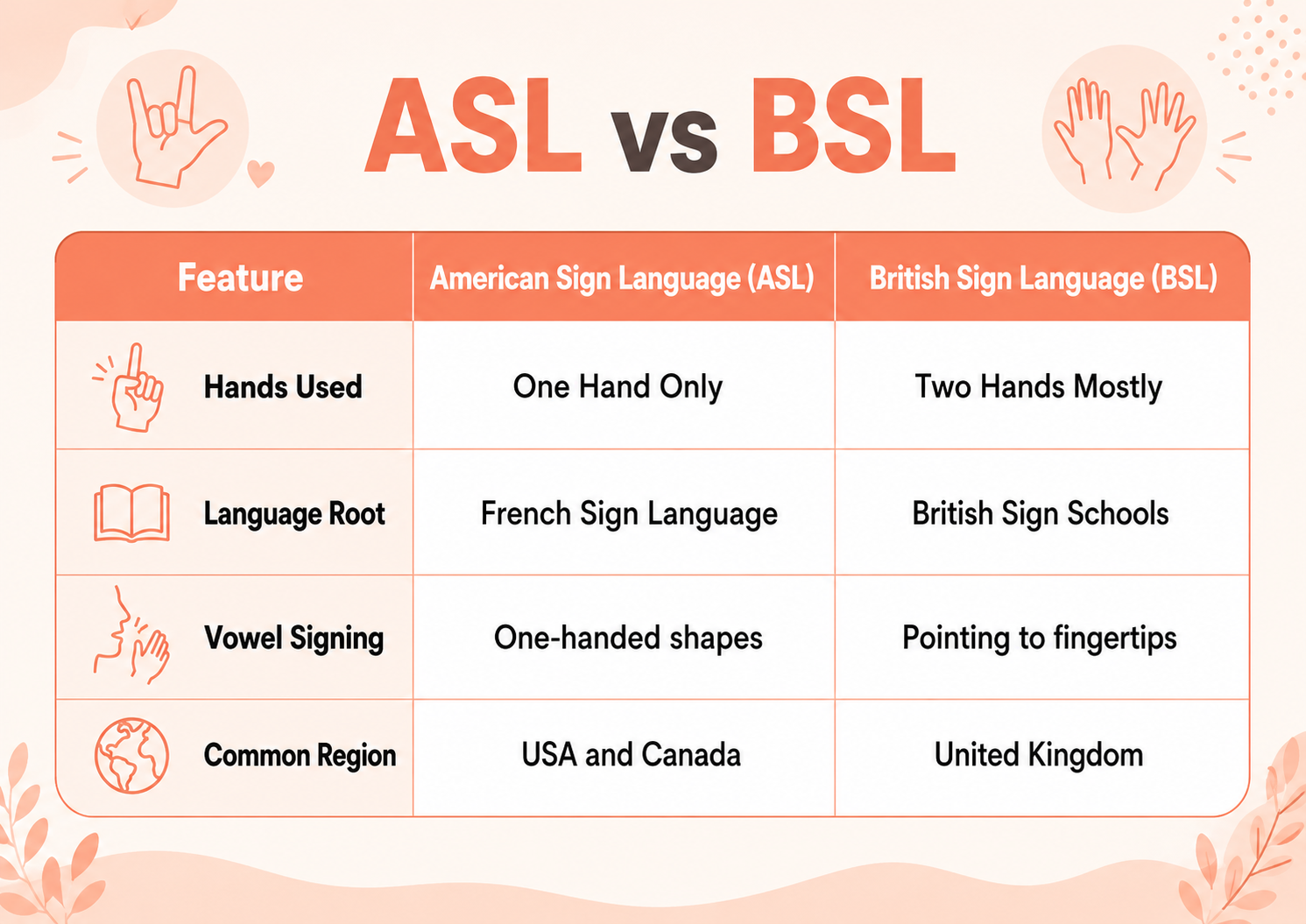
History tells us a very interesting story about why these two systems split. Way back in the 1700s, Thomas Braidwood established the first school for the Deaf in Scotland. His family used a specific British style of signing that spread across the UK.
Later on, a man named Thomas Gallaudet wanted to help Deaf children in America. He visited London to learn their teaching methods, but the schools there refused to help him.
Specifically, he then travelled to France and met a teacher named Laurent Clerc. They brought French Sign Language back to the United States together. So, ASL is actually a close relative of French signs today. In contrast, BSL grew independently within the British Isles.
How Does the Alphabet Show the Difference Between ASL and BSL?
The biggest difference is in the manual alphabet. ASL uses one hand to spell every letter, which makes fingerspelling fast. In contrast, BSL uses two hands for most letters. Vowels in BSL are shown by pointing to fingers on the other hand. Each system looks very different when spelling words or names. So learners must use the correct alphabet for their country. This helps local signers understand you clearly.
Can ASL and BSL Users Understand Each Other?
People often assume that signers can communicate across borders with no trouble. Truthfully, an American signer and a British signer share very little in common. They only share about 30% of the same signs in their daily vocabulary. This means that 70% of the language is completely different for each group.
So, they cannot have a full conversation without facing many confusing moments. Specifically, the signs for basic things like food, colours or feelings do not match. It is very similar to how a person speaking English cannot understand someone speaking Italian. Each language is a separate system with its own special identity. Anyway, this is why students must pick the right language to study before they begin their journey.
Why Do Most Signs Look Totally Different?
The vocabulary in ASL and BSL comes from different cultures. Most signs for objects and actions look completely different. This happened because both languages grew separately for many years. Each community created its own way to express ideas.
So even simple signs like ‘friend’ can look very different. This can surprise new learners who expect one system. Therefore, you must check which country the signs belong to. These differences show the creativity of Deaf communities around the world.
- Vocabulary: Most basic words do not share the same hand shapes.
- Culture: Signs often reflect local traditions and specific historical events.
- Visual style: ASL movements often look different compared to BSL movements.
What Grammar Rules Apply to These Two Systems?
Grammar in ASL and BSL works in different ways. ASL often uses topic-first sentence order. Then it adds more details after that. In contrast, BSL follows a structure closer to spoken English. Both systems use facial expressions to show meaning clearly. For example, raised eyebrows can show a question. Also, head movement helps change the tone of a sentence.
So learners must not copy spoken English rules directly. Instead, they should follow the natural flow of each sign language. This makes communication clear and smooth. Understanding grammar helps you sign with confidence and avoid common beginner mistakes.
How Does Counting Change in Both Languages?
Numbers are another area where you will see a big change between systems. ASL signers usually count from one to ten using only a single hand. They change the direction of their palm to show different groups of numbers. Specifically, the palm faces inward for one through five and outward for six through ten.
BSL users often use two hands to show numbers larger than five. This makes the numbers very clear for people watching from a distance. So, you must learn the specific finger shapes for your own city. Using the wrong number signs can lead to small mistakes during your conversations. Truthfully, practising your numbers in front of a mirror is a great way to improve.
Where in the World are These Languages Used?
Geography is the biggest factor when deciding which sign language to learn. ASL is the dominant system in North America, including the United States and Canada. It is also used in some parts of West Africa and Southeast Asia.
BSL is the primary language for the Deaf community across the United Kingdom. The unexpected thing is that Australia and New Zealand use systems very close to BSL. This is because of the shared history between these countries and Britain.
Anyway, you should always choose the system used in your own neighbourhood. It ensures that you can actually use your new skills with the people you meet. Overall, location determines how useful your signing will be.
Why are Facial Expressions So Important for Signers?
Facial expressions are significant in sign language. They show emotion and help explain meaning. Eyebrows and mouth movements can also change a sentence into a question or command. So always use your face while signing to make communication clear and natural.
- Grammar: Eyebrows indicate whether you are asking a “who” or “why” question.
- Emotion: Your face shows the intensity of the sign you are making.
- Punctuation: Head tilts and mouth patterns act like commas and periods.
How Many Sign Languages are Used Globally?
The world contains a huge variety of different sign systems. Experts believe there are over 300 unique sign languages used by different cultures. Every country usually develops its own way of speaking with hands and faces.
For example, Japanese Sign Language is completely different from Mexican Sign Language. Even countries that share a border can have totally different signs. Truthfully, this diversity shows that signing is a natural part of human life.
It is not something that was invented in just one place for everyone. Anyway, technology is helping us discover more about these languages every single day. So, the world of signing is much larger than most people ever realise at first.
Why Did the UK Give BSL Official Status?
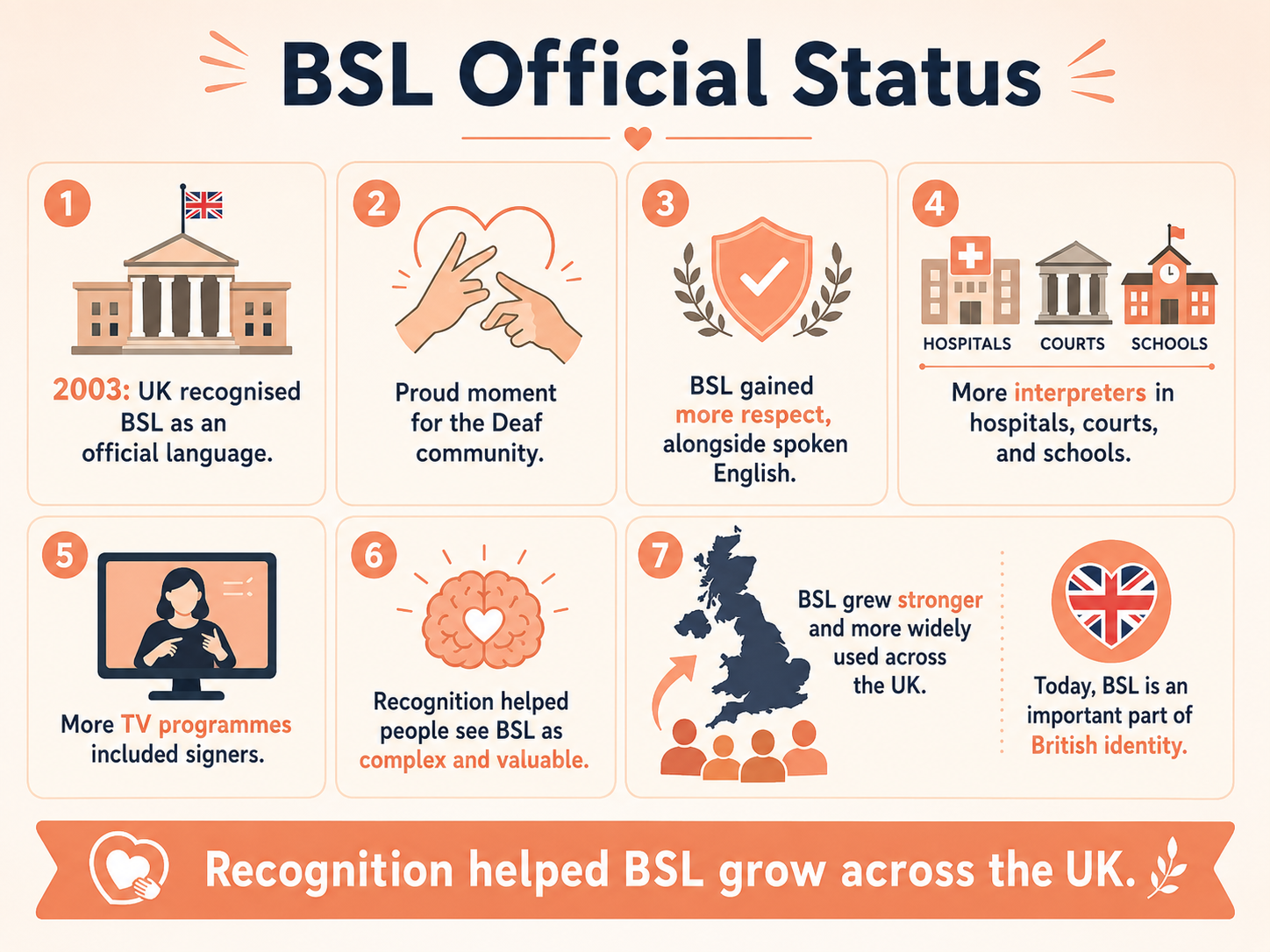
The British government officially recognised BSL as a real language in 2003. This was a very proud moment for the Deaf community in the United Kingdom. Specifically, people started respecting BSL just as much as spoken English. This change led organisations to hire more interpreters for hospitals, courts and schools.
It also meant that more television programmes started to include signers on the screen. Before this happened, many people did not realise how complex and beautiful the language was. Truthfully, this recognition helped BSL grow much stronger and more popular across the country. Anyway, this official status makes it a very important language for students to learn today. Overall, it is part of British identity.
How Can Students Start Learning BSL Today?
Taking the first step into the world of signing is a very exciting journey. Actually, you can find many great resources right in your own town or online. Most local colleges offer beginner classes where you can meet other students. Then, you can practise your hand shapes and sentences with real people. But you must be consistent and practise a little bit every single day.
Watching videos of native signers helps you see the correct movements and expressions. So, do not be afraid to make small mistakes as you learn new signs. Truthfully, the Deaf community is usually very happy to see people trying to learn their language. Anyway, picking up a few signs today builds your confidence.
Why Do People Think Sign Language is Universal?
Many people think sign language is universal because it looks very visual. At first sight, hand movements and facial expressions seem similar. So beginners often assume all signers use the same system. However, this is not true in real life. Actually, each country has its own sign language with unique rules.
ASL and BSL use different grammar and words. Also, each language grows from its own culture and history. So, signs do not mean the same in every country. One sign in ASL can mean something different in BSL. Because of this, learners must be careful when switching between them. Knowing this helps you avoid mistakes. It also helps you respect each sign language better.
Final Thoughts
Understanding sign languages helps us see how people communicate in different ways. The difference between ASL and BSL appears in grammar, hand shapes and culture. ASL is mainly used in the US and Canada, while BSL is used in the UK. Both systems carry a unique history and identity. Learning the difference between ASL and BSL helps learners choose the right language and respect Deaf communities more deeply.
FAQs
1. Is it better to learn ASL or BSL?
- It depends on where you live, so ASL fits North America while BSL fits the UK better.
2. Can ASL users understand BSL?
- No, ASL users cannot easily understand BSL because both use different signs and grammar.
3. Which is harder, BSL or ASL?
- Neither is harder, but difficulty depends on the learner’s exposure and practice.
4. Does the UK use ASL or BSL?
- The UK mainly uses BSL as its national sign language.
5. Why was BSL banned in the UK?
- People did not officially ban BSL, but schools discouraged it for many years.
6. How do you say poo in BSL?
- There is a sign for it and people use it in informal and context-based situations.
7. How do you say fart in BSL?
- BSL has a sign for it, and people use it in casual or humorous situations.
8. What is the 3 to 3 poop rule?
- It is not a standard BSL rule and may vary by context or teaching method.