Safe henna brands do more than promise natural colour. They show what is inside the pack, how the product should work, and what buyers should avoid. Some henna products hide harsh dyes behind words like herbal, black, or fast colour. So, the smart choice starts with the label. How to choose safe henna brands without harmful chemicals comes down to checking plant names, clear ingredients, seller details, and realistic colour claims before you buy.
Now, let’s explore the essential answers you need before choosing a henna product for your hair or skin.
What Makes Safe Henna Brands Easy to Trust?
Safe henna brands make safety easy to check. They show full ingredients, plant names, batch details, storage advice and patch-test steps. They do not hide behind vague herbal claims or instant black-colour promises. A trustworthy brand treats its customers like researchers, providing all the data needed to make an informed decision.
What should a trusted henna brand show first?
When you are scanning the shelves or browsing online, you need to look for transparency. A brand that wants your trust won’t make you hunt for basic information. What matters most is that the packaging clearly lists the botanical name Lawsonia inermis alongside a clear best-before date.
You should expect to see:
- A complete list of every ingredient inside.
- Instructions that mention a dye release time (real henna isn’t instant).
- Storage warnings to keep the powder away from heat and light.
- Clear contact details for the company based here in the UK.
Why should buyers read the back label first?
The easiest rule for how to choose safe henna brands without harmful chemicals is to ignore the front promise and check the back label first. The front of the box is where the sales pitch happens, using beautiful imagery and vague words like ‘organic’ or ‘ayurvedic’. The back label is where the legal reality lives. If the front says ‘Natural Black’ but the back lists p-Phenylenediamine, you are holding a chemical dye, not pure henna.
What are the early signs of a risky henna brand?
Think of these as smoke signals for a potentially dangerous product. If the brand is missing a batch number, it means they cannot track the product if something goes wrong. If there is no patch test advice, they are not prioritising your skin safety. Also, watch out for products that claim to be shelf-stable in a pre-mixed liquid or paste form without being kept in a freezer. Real henna paste loses its dyeing power very quickly unless it is frozen, so a room-temperature cone that lasts for months is usually full of preservatives and dyes.
What Is Real Henna Made From?
Real henna comes from the Lawsonia inermis plant. Its natural dye gives orange, copper, red or reddish-brown tones. Pure henna does not create instant black colour. If a product promises jet-black results fast, it needs careful checking because the henna leaf itself does not possess a black pigment.
What does Lawsonia inermis mean?
This is the scientific name for the henna shrub. Seeing this on a label is a great sign because it shows the brand is using internationally recognised cosmetic standards. The remarkable thing is that this single plant has been used for thousands of years across Africa, the Middle East, and South Asia for the exact same purpose: safely staining the skin and hair.
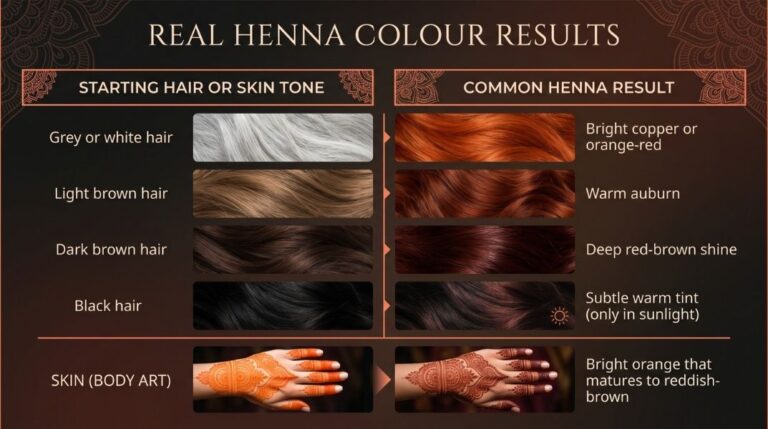
What colour can real henna give?
Real henna is translucent. It works like a wood stain rather than paint. This means your starting colour determines the final result.
Why does real henna need time?
Natural henna needs a few hours to release its dye from the leaf powder. Once you apply it, it then needs several more hours to soak into your hair or skin. Even after you wash it off, the colour is not finished. It undergoes a process called oxidation. This is where the orange tones settle into a deeper red over a day or two.
Why is instant black colour not real henna behaviour?
If a powder turns your hair black in 20 minutes, it is not henna. It is likely using a booster like PPD or metallic salts. These chemicals are used to mimic the look of henna while cutting down the time, but they carry risks that pure plant powders simply do not have.
Why Is Black Henna Riskier Than Natural Henna?
Black henna is risky because many products use chemical dyes to create fast dark colours. Natural henna does not turn skin or hair jet black instantly. A fast black colour can point to PPD or other harsh additives that are known to cause severe allergic reactions in a significant percentage of the population.
What is PPD in black henna?
PPD stands for para-phenylenediamine. It is a chemical found in most permanent hair dyes sold in supermarkets. While it is legal for hair dye under strict regulations, it is often added to black henna in much higher, unregulated amounts. The biggest issue is that when PPD is applied to the skin in a temporary tattoo, it can cause sensitisation, meaning you could become allergic to all hair dyes for the rest of your life.
Which black henna signs should buyers avoid?
Keep an eye out for these red flags:
- The No-Wait Promise: Anything that says it works in under 30 minutes.
- The Jet-Black Paste: Real henna paste is brownish-green; black henna paste is usually ink-black.
- Chemical Odour: If it smells like bleach or mothballs instead of dried grass.
- Staining Speed: If it leaves a dark stain on your skin after only two minutes.
Why can black henna affect future hair dye use?
If you have a reaction to black henna, your immune system essentially tags that chemical as an enemy. Later on, if you use a standard permanent hair dye from a salon, your body might react violently. This can lead to hospitalisation, severe swelling, and permanent scarring.
Evidence Block (NHS Advice): The NHS warns that black henna is not henna at all. They state that the chemical PPD can cause painful skin burns and may leave you with a lifelong allergy to hair dye.
What Should a UK Henna Label Show Before You Buy?
A henna product sold as a cosmetic in Great Britain should show clear label details. Buyers should look for ingredients, use instructions, batch information, precautions, use-by details and responsible seller information. These laws are in place to ensure that if a product is unsafe, it can be tracked and pulled from the market.
Which label details matter most?
The simple fact is that a product without a Responsible Person address in the UK is technically being sold illegally. You want to see:
- Full INCI Ingredients: These are the standardised names for ingredients.
- Safety Warnings: Specific text about not using it on broken skin.
- The Batch Number: Crucial for identifying if a specific lot was contaminated.
- Country of Origin: Knowing where the plant was grown and packaged.
Which label words should make buyers careful?
Do not be fooled by Professional Strength or Super Fast. These are often used to justify the inclusion of stronger chemical dyes. Similarly, ‘100% Herbal’ does not actually mean ‘100% Plant-based’. A brand can use herbal extracts as a base but still add synthetic dyes to make the colour pop.
Why can herbal still mislead buyers?
People often associate ‘herbal’ with ‘safe’. However, tobacco is herbal, and so is poison ivy. In the cosmetic world, herbal is a marketing term, not a safety category. You have to be the investigator. Look past the green leaves on the box and find the actual chemical list.
Evidence Block (GOV.UK Regulation): According to UK cosmetic safety regulations, all products must have a Product Information File and be registered on the UK cosmetic notification portal to ensure they meet safety standards for the public.
Which Henna Label Ingredients Should You Accept or Reject?
A safer henna label should have a short and clear ingredient list. Good signs include plant names like Lawsonia inermis, indigo, cassia or amla. Warning signs include PPD, metallic salts, sodium picramate and hidden synthetic dyes that are not clearly explained.
Which plant ingredients are acceptable on a label?
You should feel comfortable seeing these:
- Lawsonia inermis: The henna itself.
- Indigofera tinctoria: Indigo powder, used for brown and black tones.
- Cassia obovata: Often called neutral henna, it adds shine.
- Emblica officinalis: Amla, which helps with hair texture and colour tone.
Which ingredients should make buyers stop?
The reality is that many manufacturers add fillers to make the powder cheaper. You should reject:
- PPD (p-Phenylenediamine): The most common allergen in fast dyes.
- Sodium Picramate: A salt used to make henna turn red faster; it can be very irritating.
- Metallic Salts (Lead Acetate or Silver Nitrate): These can cause hair to smoke or break off if you ever try to use chemical bleach later.
Why are many-shade henna boxes suspicious?
If a brand offers Ash Blonde, Burgundy, and Jet Black all in one-step boxes, look closely. It is very difficult to get these specific shades using only plants in a single mix. Usually, these boxes contain compound henna, which is a mix of henna and synthetic dyes.
What does a clean ingredient list look like?
A clean list is usually very short. For example: Ingredients: Lawsonia Inermis Leaf Powder. That is it. If you are buying a brown shade, it might say: Ingredients: Lawsonia Inermis, Indigofera Tinctoria. If the list looks like a chemistry textbook, it is time to put the box back on the shelf.
What Type of Henna Powder Should You Choose?
The best henna powder depends on the purpose. Hair colour, grey coverage, body art and dark hair results may need different powders or kits. Fresh, finely sifted and clearly labelled powder gives better control over the final colour and makes it much easier to rinse out.
What is body art quality henna?
This is often called BAQ henna. It refers to powder that has been sifted through a very fine mesh to remove all sticks and sand. The interesting thing is that while it is intended for skin art, it is actually the best choice for hair as well. Because it is so fine, it creates a creamy paste that does not clump or feel like mud in your hair.
What is organic henna?
Organic mainly explains how farmers grew the plant: without synthetic pesticides. While this is great for the environment and reduces chemical residue, you still need to check the ingredients. An organic box can still have non-organic chemical dyes added later in the factory.
What are Jamila, Rajasthani and Moroccan henna?
- Jamila: Known for being incredibly smooth and giving a consistent, bright orange-red.
- Rajasthani: Often has a high dye content, resulting in a deeper, more mahogany red.
- Moroccan: Traditionally releases its dye much faster than the others, which is great if you do not want to wait 12 hours for your paste to be ready.
Why does freshness matter?
Henna is a leaf. Just like the dried herbs in your kitchen, it loses its punch over time. Old henna will produce a dull, faint colour. Always check for a harvest date. If the powder is a dull grey-green instead of a vibrant, bright green, it is probably past its prime.
Which Safe Henna Brands and UK Suppliers Should You Check?
UK buyers should check suppliers that show clear ingredients, safety advice and product purpose. Renaissance Henna and its pure form are useful UK options from available research. International brands can also be researched, but you must remember that each exact product label still matters more than the brand name.
Which UK suppliers are worth checking?
The biggest benefit is that these companies specialise in henna, so they understand the science behind it.
- Renaissance Henna: They provide incredibly deep guides and pure, sifted powders.
- It’s Pure: The first brand in the UK to get Soil Association organic certification for its henna.
- Henna Shop and Mehndi Seasons: These are go-to spots for quality body art supplies that are safe for the skin.
Which international brands may buyers research?
You might see these online. Just make sure you are buying from the official distributor so you do not get a knock-off version:
- Light Mountain and Henna Sooq: Very popular in the US and known for purity.
- Khadi and Radico: German and Indian brands that follow very strict safety standards.
- Cultivators: Known for high-quality, Fair Trade organic powders.
Why should every product label still be checked?
Brands change their recipes. A brand that was 100% natural three years ago might introduce a new fast-acting line today that contains chemicals. Also, counterfeit products are common. A box might look like Khadi, but if you bought it from a random seller for a low price, it might be a fake.
Which Henna Products Should You Avoid?
Buyers should avoid henna products with instant black claims, missing ingredients, unclear sellers or chemical dye warnings. The challenge is that these products are often the cheapest and most widely available in local high-street grocery stores.
Which hair henna products need extra checking?
Based on various safety reports and consumer feedback regarding additives, be very careful with:
- Reshma, Godrej, and Vatika: Often sold as herbal but may contain metallic salts or PPD in certain varieties.
- Nisha and Noorani: Frequently found to have fast-acting chemical boosters.
- Patanjali Kesh Kanti: Marketed as pure but check the back for synthetic additives.
Which henna skin products need extra checking?
Ready-made cones are the biggest risk for skin. Avoid:
- Golecha and Kaveri: These often contain preservatives and dyes to make them shelf-stable at room temperature.
- Neha and Prem Dulhan: Famous brands, but their pre-mixed cones have been flagged in the past for skin irritation.
Why can good reviews still mislead buyers?
Someone might leave a 5-star review saying, “Amazing! Turned my hair jet black in 10 minutes!” To an investigator, that is actually a 1-star safety warning. The reviewer is happy with the colour, but they do not realise they have just applied a high concentration of unlisted chemicals to their scalp.
Should You Buy Henna From Amazon, Etsy, Temu or eBay?
Buying henna from large marketplaces can be risky when the seller is unclear. The product may be old, copied, badly stored or wrongly labelled. The unexpected thing is that even if the listing shows a natural product, the warehouse might send you a different version of the same brand that contains chemicals.
What can go wrong on marketplaces?
- Storage Issues: Henna needs to stay cool. Online warehouses can get very hot, which kills the dye.
- Fake Packaging: There are factories that specialise in making boxes that look exactly like organic brands but fill them with cheap, dangerous powder.
- Zero Accountability: If you have a reaction, an anonymous seller on a discount site is not going to help you.
When is the marketplace buying less riskily?
It is okay if the seller is the official brand. If it is pure and has an official shop on a major platform, you are getting the real thing. Always click on the seller name to see who is actually sending the package.
What should buyers check before paying?
Take thirty seconds to look at the seller information. If they have no website, no physical address, and the reviews mention chemical smells, just keep looking. It is not worth the risk to your hair or health.
Can Henna Damage Hair or Cause Hair Loss?
Pure henna does not usually damage hair like strong chemical dyes. In fact, it often makes hair feel thicker and stronger. The fact is that any problems usually come from hidden additives or poor application methods rather than the henna plant itself.
Why can hair feel dry after henna?
Henna is a protein treatment. If your hair is already very dry, adding henna can make it feel stiff. This is not damage: it is just a temporary texture change. A good conditioning treatment after you rinse the henna out will usually fix this immediately.
What causes breakage during henna use?
This usually happens for two reasons:
- Low-Quality Powder: If the powder is gritty like sand, it is hard to rinse. People often rub their hair roughly to get the grit out, which snaps the strands.
- Metallic Salts: If your hair has metallic salts from a cheap henna brand and you then use chemical dye or bleach, a chemical reaction occurs that can literally melt the hair.
Why is henna hard to remove?
Henna is permanent. It does not just sit on the surface: it binds with the hair’s keratin. If you are someone who likes to change your hair colour every month, henna is a bad choice because you cannot simply dye over it with a lighter colour.
How Can You Get Black Hair Without Black Henna?
Black hair usually needs a two-step henna and indigo method. The surprising part is that you can achieve a jet-black, shiny result using only plants, but it takes two separate applications. This is the only safe way to avoid the risks of PPD-filled black henna.
Why is henna alone not enough for black hair?
As we have discussed, henna is only red. Indigo is another plant that produces a blue-black dye. When you put blue over red, you get black. If you just use indigo alone on grey hair, it often turns a strange swamp-green. The red henna base is essential.
Why do separate powders work better?
Some brands sell One-Step Black which is a mix of henna and indigo in one bag. These can work for dark brown, but for a true jet black, the two-step method is king. It ensures the henna binds first, creating the anchor for the indigo to latch onto.
Should you use lemon juice?
Many old-school guides say to mix henna with lemon juice. Looking at it another way, lemon is very acidic and can be quite drying for the hair. Many experts now suggest using something gentler, like apple juice or even just warm water, to keep the hair’s moisture balanced.
What Is the Smart Henna Safety Checklist?
A smart henna safety checklist helps buyers avoid risky products before full use. You should check the label, ingredients, seller, batch details and patch-test advice. The honest truth is that even with 100% natural products, you could still have a personal allergy, so testing is never optional.
What should buyers check before buying?
Here are the key things to check:
- Does the box list the botanical name Lawsonia inermis?
- Is the ingredient list short and easy to understand?
- Is the seller a recognised specialist or an official brand store?
- Does the price seem too good to be true for a high-quality plant product?
How should buyers patch test henna?
Mix a small spoonful of powder with water and apply it to the crook of your elbow. Leave it for at least 30 minutes, rinse, and then wait 48 hours. If you see any redness, itching, or swelling, do not put it on your head.
What warning signs matter?
If you feel burning or see blisters, seek medical advice immediately. This is a sign of a chemical reaction, likely to PPD. Pure henna should never cause a burning sensation.
Final Thoughts: How Do Safe Henna Brands Earn Trust?
Safe henna brands earn trust by showing clear ingredients, realistic colour timing, batch details and safety guidance. They do not promise instant black colour or hide behind vague herbal claims. A safer henna choice starts with the label and ends with a successful patch test.
Choose henna just like your food. Read the ingredients first, trust slow colour and avoid anything that hides what it contains. By sticking to pure powders and trusted UK suppliers, you can enjoy the hair-strengthening benefits of this ancient plant without the modern-day risks of black henna chemicals.